Indigo is arguably the most culturally significant dye in human history. Long before synthetic chemistry made blue pigments affordable, civilisations across the globe independently discovered that the leaves of certain plants — Indigofera tinctoria in India, Isatis tinctoria (woad) in Europe, and Polygonum tinctorium in Japan — could yield a profound, lightfast blue through a process of fermentation and oxidation. India's contribution to this global story is foundational: the very word "indigo" derives from the Greek "indikon," meaning "from India," and for millennia, Indian indigo was the world's most coveted textile dye, traded along the Silk Road and across the Indian Ocean.
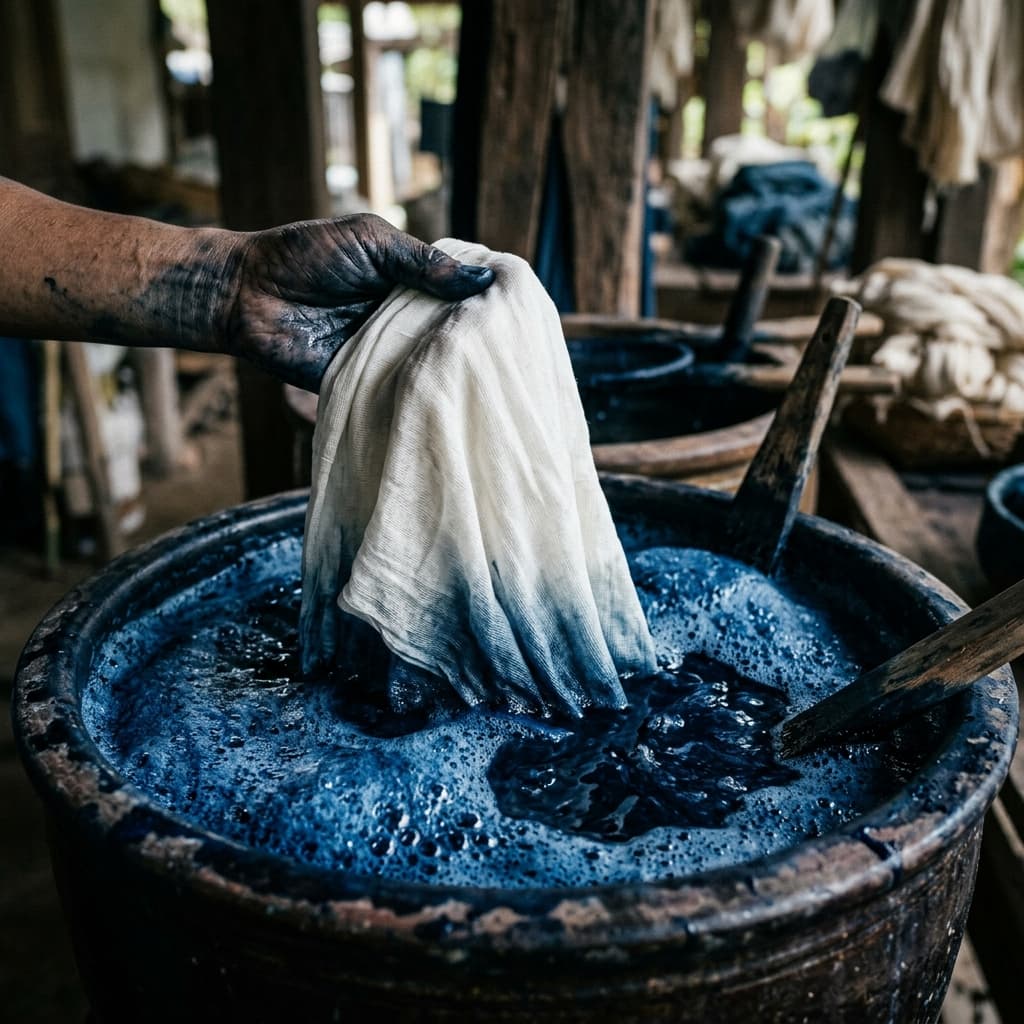
The chemistry of natural indigo dyeing is fascinating in its complexity. Unlike most natural dyes, indigo is not water-soluble in its coloured form. The blue pigment, indigotin, must first be reduced to its soluble leuco form through an alkaline fermentation process. Traditional Indian dyers achieve this by building a vat of aged indigo paste, slaked lime (calcium hydroxide), and a source of natural sugar — often jaggery, overripe bananas, or dates — which feeds the anaerobic bacteria responsible for the reduction reaction. The resulting yellowish-green liquid looks nothing like blue, yet when fabric is dipped and then exposed to air, the leuco-indigo oxidises back to its insoluble blue form, locking permanently into the fibre structure.
The skill of maintaining an indigo vat is often compared to tending a living organism, and rightly so. The vat is a carefully balanced microbial ecosystem. The fermentation bacteria require precise pH levels (typically between 10 and 12), consistent temperature (ideally 25 to 35 degrees Celsius), and regular feeding with fresh reducing sugars. Master dyers in Rajasthan's Bagru and Gujarat's Ajrakhpur have developed an intuitive understanding of their vats over decades, reading the surface foam, smelling the fermentation gases, and tasting the alkalinity to judge the vat's health. This knowledge, passed from master to apprentice, represents an irreplaceable form of biochemical expertise that predates laboratory science by centuries.
The depth and character of indigo-dyed textiles cannot be replicated by synthetic alternatives. Natural indigo builds colour through repeated dipping and oxidation cycles — a process called "saddening." Each dip adds another molecular layer of indigotin to the fibre, creating the characteristic depth and dimensionality that distinguishes hand-dyed indigo from flat, uniform synthetic blues. A fabric that has been dipped twenty times will show a rich, almost black navy that gradually reveals lighter blue undertones as it ages and wears. This living quality, where the fabric's colour evolves with its owner, is central to the enduring appeal of natural indigo textiles.
Beyond indigo, India's tradition of organic pigment fermentation encompasses a remarkable range of colours. Madder root (Rubia tinctorum) yields a spectrum from soft coral to deep crimson through aluminium and iron mordanting. Pomegranate rind produces warm golds and olive greens depending on the mordant used. Lac, a resin secreted by the Kerria lacca insect, creates brilliant scarlets and crimsons that rival any synthetic dye for vibrancy. Myrobalan (Terminalia chebula) serves as both a dye source and a mordant, producing soft yellows while improving the washfastness of other natural dyes applied in subsequent baths.
The modern revival of natural dyeing is driven by growing consumer awareness of the environmental and health costs of synthetic dyes. The textile industry is the second-largest polluter of fresh water globally, and synthetic dye effluent contains heavy metals, formaldehyde, and chlorinated solvents that devastate aquatic ecosystems. Natural dyes, when properly sourced and applied, generate biodegradable waste streams and require no petrochemical inputs. For wholesalers and brands committed to genuine sustainability, naturally dyed fabrics offer not just an environmental advantage but a powerful story of cultural continuity — connecting today's consumers to dyeing traditions that have sustained communities for generations.