

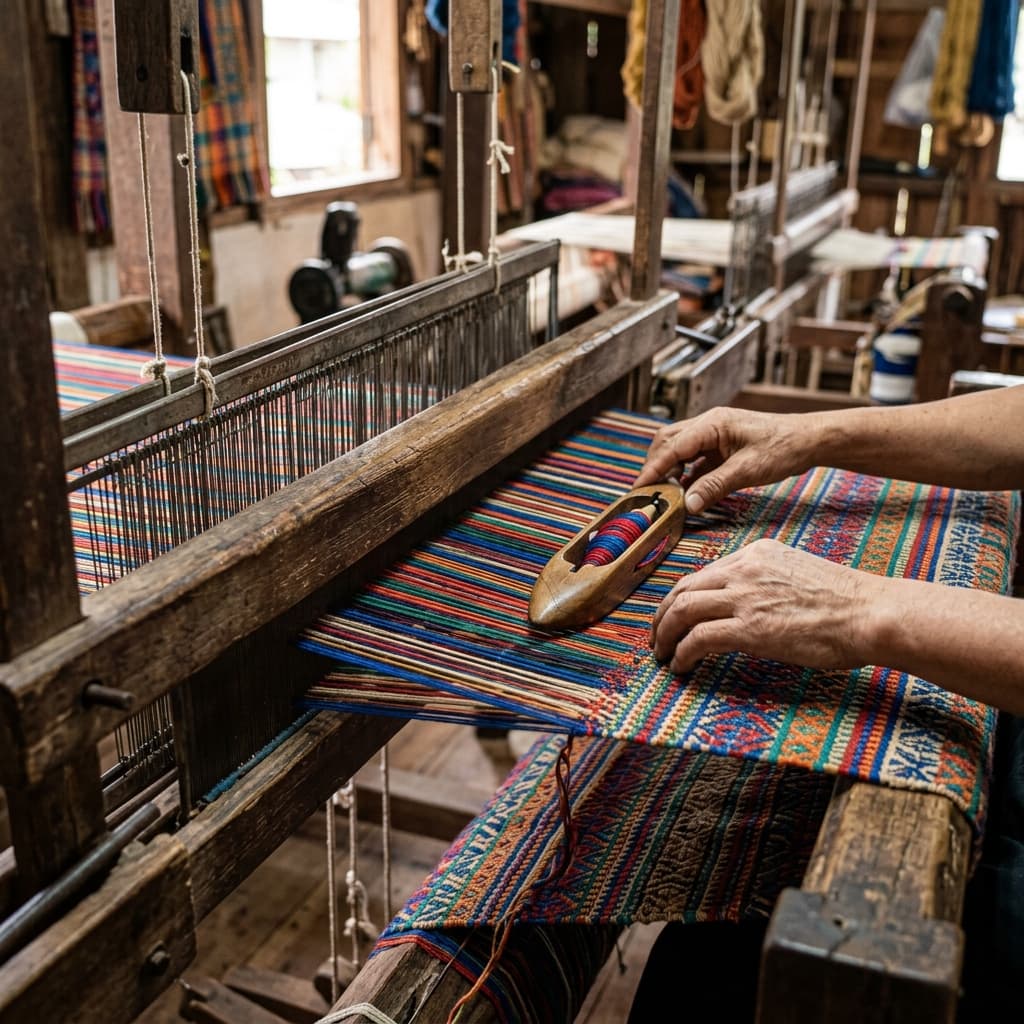

The handloom has been the backbone of Indian textile culture for thousands of years. From the ancient pit looms carved into the earth of rural Bihar to the sophisticated jacquard mechanisms of Varanasi, the evolution of weaving technology is a story of human ingenuity meeting artistic ambition. In recent years, a quiet revolution has been unfolding across India's weaving clusters: the rise of wireless, sensor-equipped looms that preserve the artisan's touch while dramatically improving consistency, efficiency, and working conditions.
Traditional shuttle looms operate on a simple but physically demanding principle. The weaver manually throws a wooden shuttle carrying the weft thread back and forth across the warp, pressing each row tight with a reed. This repetitive motion, performed thousands of times per day, leads to chronic shoulder and wrist injuries among artisans. The fly shuttle, invented by John Kay in 1733, mechanised the throwing motion but retained the foot-operated treadle system. Modern wireless looms take this a step further by integrating microcontrollers that regulate shuttle speed, warp tension, and beat-up force through Bluetooth-connected sensors, giving weavers real-time feedback on fabric density without altering the fundamental hand-guided process.
One of the most significant advantages of wireless loom technology is quality consistency. In traditional handloom weaving, even the most skilled artisan experiences natural variation in tension and rhythm throughout a long working day. These micro-variations, while sometimes celebrated as the charm of handmade textiles, can be problematic for commercial buyers who require bolt-to-bolt uniformity. Wireless tension monitors attached to the warp beam continuously measure thread stress in grams per denier, alerting the weaver through a subtle vibration when tension drifts outside the target range. This ensures that the first metre of fabric woven in the morning matches the last metre woven in the evening.
The integration of wireless technology also opens new possibilities for pattern complexity. Traditional dobby looms use punched cards or pegged cylinders to control which harness frames lift for each pick. Digital dobby systems replace these mechanical selectors with electronically controlled solenoids, allowing weavers to load intricate geometric patterns from a smartphone app. Artisans in Bhagalpur and Maheshwar have begun using these systems to reproduce complex Madhubani-inspired motifs directly into silk and cotton weaves, creating fabrics that carry the region's artistic DNA in their very structure rather than as surface-applied prints.
Perhaps most importantly, wireless loom technology preserves livelihoods. Unlike power looms that replace human labour entirely, these hybrid systems augment the weaver's skill. The artisan still controls the creative decisions: colour sequencing, pattern placement, and the subtle textural choices that distinguish handloom from machine-made fabric. The technology simply removes the physical strain and quality inconsistency that have driven younger generations away from the craft. Government initiatives like the National Handloom Development Programme are now subsidising wireless retrofit kits for existing looms, making this technology accessible even to weavers in remote villages.
The environmental footprint of wireless handlooms deserves special attention. Unlike power looms that consume significant electrical energy and generate noise pollution, wireless-assisted handlooms remain human-powered at their core. The sensor modules run on small rechargeable batteries that last weeks on a single charge. The carbon footprint per metre of fabric remains negligible compared to mill-produced textiles. For brands building sustainability credentials, wireless handloom fabrics offer a compelling narrative: cutting-edge technology in service of an ancient, zero-emission production method.